

Still writing vague goals like “improve communication” and hoping for a promotion?
You’re not alone—most people hit a review with unclear targets.
Professional development goals work best when they’re specific, measurable, and tied to real tasks and dates.
This post gives 25 practical examples you can copy and adapt: short-term wins, long-term certification plans, leadership moves, and skill upgrades.
Pick the one that fits your role, add numbers and deadlines, and you’ll enter your next review with proof, not promises.
Comprehensive Overview of Professional Development Goal Examples

Professional development goals are specific, written statements that describe what you want to learn, build, or improve in your work. Think gaining a new skill, earning a certification, or leading a team project. People search for concrete examples because they need starting points for performance reviews, career conversations with managers, and personal development plans. You don’t want to sit down with a blank document. You want to see what works.
Effective examples always include measurable outcomes. Instead of “get better at presenting,” write “Deliver a 15-minute presentation at the next department meeting by July 30.” Instead of “improve time management,” try “Attend a time-management workshop by end of Q2 and reduce task overflow by 20% within 90 days.” These numbers and deadlines make success visible and hold you accountable.
Here are 10 short, measurable examples across common development areas:
- Complete a certified Power BI course by end of Q3 and deliver one analytics dashboard by Q4.
- Join Toastmasters or a virtual speaking course and present at one internal event by December 31.
- Enroll in a people-management program, hold weekly coaching conversations, and collect 360° feedback every 6 months.
- Take a business writing course and apply best practices to weekly reports for 3 months.
- Attend one networking event per quarter and follow up with at least 3 contacts after each event.
- Contribute to at least one cross-functional initiative per quarter and request peer feedback at quarter close.
- Complete a role-aligned certification (e.g., SHRM-CP, PMP, Salesforce Admin) within 6 months.
- Learn industry-relevant tech (SQL, APIs, cybersecurity basics) and apply on at least one internal project by year-end.
- Attend DEI training, participate in an employee resource group, and facilitate quarterly roundtables.
- Request feedback from at least two peers or leaders after major projects and set one improvement goal within 30 days.
These categories map onto what managers look for during reviews: new capabilities, project impact, soft skills, collaboration, and measurable progress. Pick one or two that align with your role and your company’s goals, then customize them with your own numbers and deadlines.
SMART Framework for Creating Strong Professional Development Goal Examples

The SMART framework turns a vague intention into a clear target. SMART stands for Specific, Measurable, Achievable, Relevant, and Time-bound. When you follow this model, you define exactly what “done” looks like. And you increase the probability of actually finishing.
Here’s what each piece means:
- Specific — state exactly what you’ll do and why. “Improve my skills” is too broad. “Complete a Power BI certification course to support data-driven HR decisions” is specific.
- Measurable — include a number, metric, or output so you can track progress. For example, “Read 12 business books this year” or “Reduce customer complaints by 20% in six months.”
- Achievable — make sure the goal fits your current workload, resources, and skill level. Don’t commit to earning an AWS certification in three weeks if you’ve never touched cloud infrastructure.
- Relevant — tie the goal to your role, team priorities, or career path. If your company doesn’t use Power BI and never will, that course won’t move you forward.
- Time-bound — set a deadline. “By end of Q2,” “within 90 days,” “by July 30,” or “in the next 12 months.”
Here are two full SMART examples pulled from common development scenarios. “Complete an online Power BI certification course by end of Q3 and deliver one HR analytics dashboard to support a business decision by Q4.” That’s specific (Power BI course + dashboard), measurable (one dashboard delivered), achievable (assumes access to data and stakeholder support), relevant (improves analytics capability), and time-bound (Q3 for course, Q4 for output).
Another: “Read one business book per month (12 books per year) and present key takeaways at monthly team huddles.” That’s specific (books + presentations), measurable (12 books, 12 huddles), achievable (one book per month is realistic), relevant (shares insights with the team), and time-bound (monthly cadence).
Short-Term Professional Development Goals Examples for Quick Wins

Short-term goals cover 30 to 90 days. They give you quick wins that show progress and build momentum. When you can check a goal off in one quarter, it feels real. You get feedback fast. You adjust and move on.
Here are six short-term examples you can start this week:
- Use time-blocking in your calendar for the next 4 weeks and track whether you complete priority tasks before end-of-day each Friday.
- Complete a 6-week Excel or data analysis course and apply one new formula or pivot table to a real work project by the course end date.
- Present at 3 internal team meetings this quarter (one per month) to practice public speaking and visibility.
- Start a weekly decision journal and log one major work decision each week for 90 days, then review patterns with a mentor.
- Choose a project-tracking tool (Trello, Asana, Notion) and use it daily for one quarter to reduce missed deadlines.
- Join one cross-functional project or working group this quarter and deliver at least one actionable insight or output by quarter close.
Quick wins increase motivation because you see results before your next performance review. Each small success proves you’re capable and builds confidence for bigger goals. When you finish a 6-week course or present three times in three months, you walk into the next quarter-planning session with proof.
Short-term goals also connect to broader performance progress. The time-blocking habit becomes the foundation for long-term productivity improvements. The decision journal turns into a leadership skill. Quick wins aren’t just check-the-box exercises. They’re building blocks for what comes next.
Long-Term Professional Development Goal Examples for Career Growth

Long-term goals stretch across 6 to 12 months or longer. They target role transitions, promotions, certifications, and strategic skill shifts. These goals require sustained effort, structured milestones, and external resources like courses, mentors, exam prep, project sponsorship.
Long-term goals prepare you for advancement. If you want to move from individual contributor to team lead, a 12-month leadership development plan builds the people-management competencies reviewers look for. If you need a certification to qualify for a new role or client project, a six-month study timeline with weekly progress checks gets you there.
| Goal | Timeframe | Outcome Metric |
|---|---|---|
| Complete a professional certification (SHRM-CP, PMP, AWS Solutions Architect) | 6 months | Pass the certification exam on the scheduled date |
| Enroll in a leadership development cohort and collect 360° feedback at start and end | 12 months | Promotion or expanded team responsibility within 12 months |
| Lead a cross-functional project from proposal through final presentation | 9 months | Project outcomes presented to leadership; measurable business impact documented |
| Learn an advanced technical skill (SQL, Python, cloud infrastructure) and deploy on two internal projects | 12 months | Two completed projects using the new skill; endorsement from project stakeholders |
| Participate in DEI training, join an employee resource group, and facilitate four quarterly roundtables | 12 months | Four roundtables facilitated; documented engagement metrics and qualitative feedback |
Each of these goals requires breaking the year into milestones. For a certification, that might mean completing one course module per month, scheduling the exam for month five, and reserving month six for a retake if needed. For a cross-functional project, you draft the proposal in month one, pitch to leadership in month two, execute in months three through seven, and present results in months eight and nine.
Long-term goals feel abstract at first. But they become real when you schedule the first milestone in your calendar and block time every week. One study session per week for six months adds up to a certification. One coaching conversation per week for a year adds up to promotion readiness.
Leadership and Management Professional Development Goal Examples

Leadership goals build the competencies that managers and executives need: coaching, strategic thinking, accountability, and cultural influence. These skills take time and practice, so leadership development often spans quarters or years, not weeks.
Leadership goals increase promotion readiness. Companies track internal promotion rates, 360° feedback trends, and leadership pipeline depth. When you can show that you’ve run coaching conversations, collected feedback, led a cross-functional initiative, and facilitated DEI sessions, you prove you’re ready for the next level.
Communication & Coaching Skills
Strong leaders communicate clearly and coach their direct reports. Measurable goals in this area include holding weekly one-on-one coaching conversations with each team member for six months, completing a coaching certification program within the same timeframe, and collecting 360° feedback at the start and midpoint of the year to track improvement.
Another example: enroll in a people-management course and apply one new coaching technique each month, then ask your team for informal feedback on which techniques helped most.
Strategic Thinking & Decision-Making
Strategic leaders make high-quality decisions under uncertainty and connect daily work to long-term business outcomes. Measurable goals include shadowing a senior leader for one quarter and logging one major decision per month in a decision journal, then reviewing patterns with a mentor.
Another: lead a side project that addresses a cross-functional problem. Draft a proposal, pitch it to leadership, execute over six months, and present measurable project outcomes at the close. Both goals force you to think beyond task completion and demonstrate business impact.
People & Culture Leadership
Leaders shape culture through inclusion, recognition, and learning. Measurable goals include attending DEI training within the first quarter, joining an employee resource group, and facilitating four quarterly roundtables on topics like psychological safety, cross-cultural collaboration, or career development.
Another: implement a quarterly team recognition practice where you celebrate individual and team wins publicly, and track engagement scores before and after to measure impact.
Here are four concise SMART examples for managers. “Hold weekly coaching conversations with each direct report for six months and collect mid-year 360° feedback to assess coaching effectiveness.” “Shadow one senior leader per quarter, document decision patterns in a journal, and review findings with your own manager monthly.” “Complete a people-management certification within six months and apply at least one new technique per month in team meetings.” “Facilitate four quarterly DEI or team-learning sessions and gather qualitative feedback after each to improve facilitation skills.”
Communication Skills Development Goal Examples

Communication is a universal professional competency. Whether you’re an engineer writing technical documentation, a manager running all-hands meetings, or an account executive pitching to clients, you need clarity, confidence, and adaptability. Development goals in this area improve how you speak, write, listen, and facilitate.
Five measurable communication goals:
- Join Toastmasters or a virtual speaking course and deliver one presentation at an internal event by December 31.
- Complete a business writing course and apply best practices (clear structure, plain language, active voice) to your weekly status reports for three months. Use Grammarly or Hemingway App to track readability improvements.
- Practice active listening by repeating back what someone says in at least one meeting per week for 90 days, then ask a colleague for feedback on whether you’re accurately capturing their points.
- Run a monthly team huddle or project debrief where you facilitate discussion (not just present slides) for six months, and collect brief feedback after each session to refine your approach.
- Take a beginner course in a second language relevant to your industry or customer base, complete it within six months, and use basic phrases in at least one client or colleague interaction per month.
Measurable elements matter. “One presentation by year-end” gives you a target. “Apply writing improvements for three months” creates a feedback loop where you can see progress in your own documents. When you track weekly active-listening practice, you turn a vague “be a better listener” into a daily habit.
Technical and Digital Skills Professional Development Goal Examples

Technical upskilling keeps you relevant as tools, platforms, and workflows change. Even if you’re not in an engineering or IT role, learning the basics of data analysis, cloud infrastructure, APIs, or cybersecurity makes you more effective and more valuable.
Seven technical skill goals:
- Learn SQL basics through a 6-week online course and write at least three queries to pull data for your own projects by course end.
- Complete a Power BI or Tableau certification by end of Q3 and deliver one analytics dashboard that supports a business decision by Q4.
- Take an API fundamentals course and use a public API (like a weather or CRM API) in one personal or work project within 90 days.
- Complete a cloud basics course (AWS Cloud Practitioner, Azure Fundamentals, or Google Cloud Essentials) within six months to understand how your company’s infrastructure works.
- Finish a cybersecurity awareness training and apply at least two new security practices (password manager, two-factor authentication) to your daily workflow within 30 days.
- Complete an 8-week Excel course covering pivot tables, VLOOKUP, and conditional formatting, then use each technique in at least one real work spreadsheet by week 9.
- Take an AI literacy or ChatGPT skills course within three months and integrate one AI workflow (like drafting email templates or summarizing meeting notes) into your weekly routine.
Measurable output is key. A dashboard delivered. A query written. A project using an API. These outputs prove you didn’t just watch videos. You applied the skill. When you list “delivered one analytics dashboard by Q4” on a performance review, your manager sees tangible impact, not just course completion.
Cross-Functional, Collaboration, and Networking Development Goal Examples

Collaboration and networking goals strengthen relationships across teams, build your internal reputation, and expand your access to opportunities. These goals are less about individual technical skills and more about how you work with others and how visible you are inside and outside your organization.
Six collaboration and networking examples:
- Participate in at least one cross-functional initiative per quarter (four per year) and solicit peer feedback from at least two collaborators after each quarter.
- Attend one to two industry conferences per year and publish one internal briefing or team presentation sharing key learnings within 30 days of each event.
- Volunteer as a mentor for one colleague or new hire, hold monthly check-ins, and set measurable mentee milestones (like skill acquisition or a completed project) over six months.
- Join one professional association or online community relevant to your field and contribute at least one discussion post or resource per month for 90 days.
- Attend one networking event per quarter (four per year) and follow up with at least three new contacts per event within one week.
- Shadow a colleague in another department for one day per quarter and document one cross-functional insight or process improvement idea after each session.
Numeric targets make these goals trackable. “One cross-functional project per quarter” and “three follow-ups per event” turn vague networking into a habit. When you request feedback after each collaboration or document insights after each shadow day, you create a feedback loop that shows growth over time.
Industry-Specific Professional Development Goal Examples

Different industries prioritize different competencies. A teacher’s development plan looks different from a software engineer’s. An HR professional’s goals differ from a healthcare worker’s. This section provides sample goals across four industries so you can see how to adapt the SMART framework to your field.
Healthcare
Healthcare professionals need clinical skill updates, compliance knowledge, patient communication training, and technology adoption. Four healthcare goals:
- Complete 20 hours of continuing medical education (CME) credits by year-end to maintain licensure and stay current on treatment protocols.
- Finish a 6-week course on electronic health record (EHR) system optimization and reduce patient chart documentation time by 15% within 90 days.
- Attend a patient communication and empathy workshop within the next quarter and apply at least two new techniques in daily patient interactions for three months.
- Complete HIPAA and data privacy recertification within 60 days and train two junior staff members on compliance best practices by quarter end.
Education
Educators focus on curriculum development, classroom management, assessment design, and technology integration. Four education goals:
- Complete a course on differentiated instruction within six months and implement at least three new strategies in lesson plans for one semester.
- Earn a Google Certified Educator or Microsoft Innovative Educator certification within 90 days and integrate at least one new edtech tool into weekly lessons.
- Attend two professional development workshops on social-emotional learning (SEL) this year and develop one new classroom practice per workshop to improve student engagement.
- Design and pilot one new project-based learning unit over one semester, collect student feedback, and present results at a staff meeting by semester end.
IT & Software
IT and software professionals need technical certifications, coding proficiency, security knowledge, and project management skills. Four IT goals:
- Pass the AWS Solutions Architect Associate certification within six months by completing one study module per week and scheduling the exam for month five.
- Learn Python basics through a 12-week online course and build one automation script that saves at least two hours per week on a recurring task.
- Complete a cybersecurity fundamentals course within 90 days and implement at least three new security controls (like endpoint monitoring or patch automation) in production systems.
- Earn a Scrum Master or Project Management Professional (PMP) certification within nine months to support cross-functional project leadership.
Engineering
Engineers need technical depth, safety and regulatory training, and system design competencies. Four engineering goals:
- Complete a Fundamentals of Engineering (FE) exam prep course and pass the FE exam within 12 months to advance toward Professional Engineer (PE) licensure.
- Take a course on CAD software (AutoCAD, SolidWorks, Revit) within six months and complete at least two design projects using the new tool by course end.
- Attend OSHA safety training and apply updated protocols on at least two job sites or lab projects within 90 days.
- Learn finite element analysis (FEA) through a structured course over six months and apply FEA to one real product design or structural validation project by year-end.
Templates and Frameworks for Writing Your Own Professional Development Goal Examples
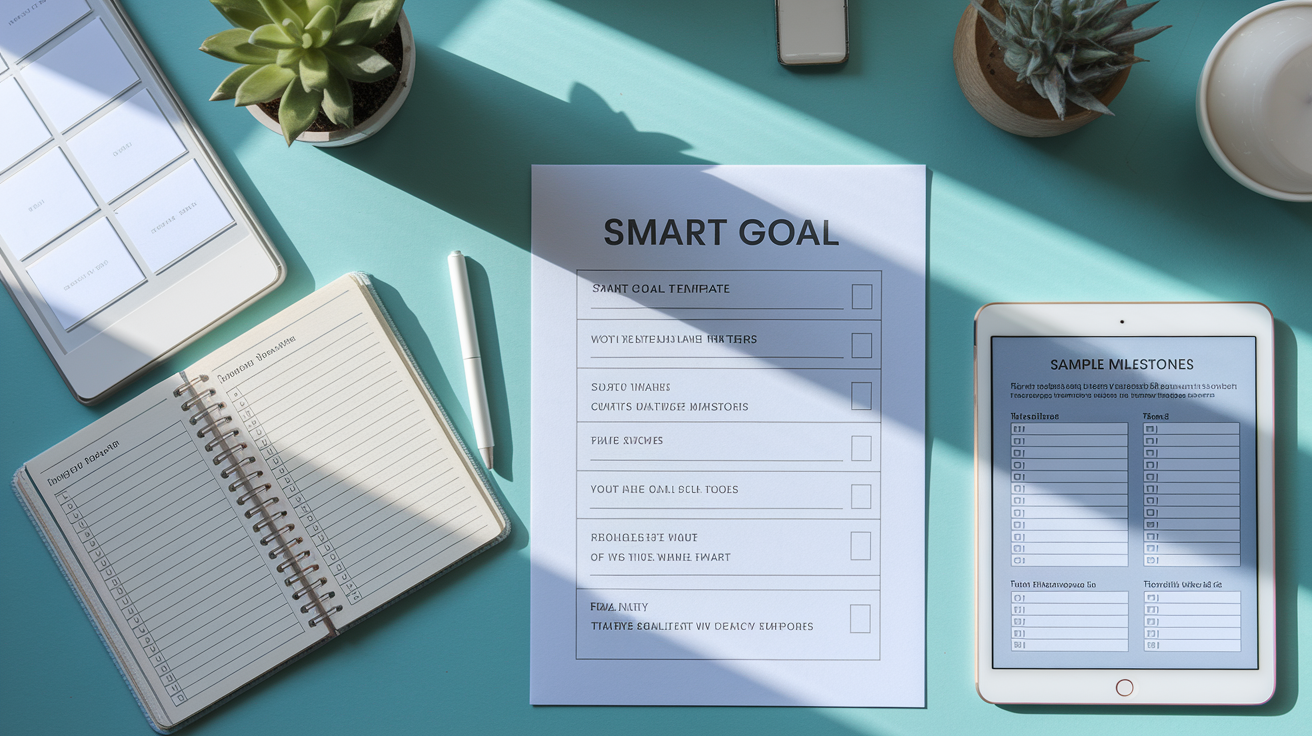
Templates reduce guesswork. Instead of staring at a blank page, you follow a checklist. You fill in the pieces. You create a SMART goal in five minutes instead of struggling for an hour.
Here’s a six-step checklist for building your own development goal:
- Assess current skills and gaps. List what you do well and what you need to improve. Use self-assessment, manager feedback, or peer input.
- Prioritize based on role and career path. Pick 2–3 gaps that matter most for your current role or next promotion.
- Write each goal in SMART format. Include what you’ll do, how you’ll measure success, required resources, and a deadline.
- Identify resources and learning modalities. Specify the course, workshop, mentor, certification, or project you need.
- Set milestones and timelines. Break long goals into monthly or quarterly checkpoints so you can track progress and adjust.
- Define KPIs and review cadence. Decide how you’ll measure success (certification pass, project completion, feedback scores) and when you’ll review (monthly, quarterly, biannually).
| Template Type | Description | Timeframe |
|---|---|---|
| Quarterly Quick-Win Goal | Pick one 30–90 day goal, define one measurable output, schedule weekly check-ins with yourself or your manager | One quarter (3 months) |
| Annual Development Plan | Choose 3–5 SMART goals across technical, leadership, and collaboration categories; assign resources and milestones; review quarterly | 12 months |
| Certification Roadmap | Select certification, set exam date, allocate weekly study hours, complete practice exams monthly, pass within 6 months | 6 months |
Templates eliminate the “where do I start?” problem. When you know the steps, you move faster. You spend less time planning and more time doing.
Integrate templates into your quarterly planning. At the start of each quarter, pull out the checklist, review your progress from last quarter, adjust your goals, and set new milestones. By the end of the year, you’ll have completed multiple development cycles instead of letting one vague goal sit untouched for 12 months.
KPI Tracking and Measurement Methods for Professional Development Goal Examples
Tracking progress turns intentions into results. KPIs (key performance indicators) show whether your development goals are working. Some KPIs are quantitative (numbers you can count). Others are qualitative (feedback, reflections, and observable behavior changes).
Quantitative KPIs for personal development goals include promotion readiness (did you get promoted or shortlisted?), training satisfaction scores (post-course surveys), engagement metrics (participation in programs, ERGs, or cross-functional projects), goal completion percentage (how many of your goals did you finish on time?), and project outcomes (did you deliver the dashboard, lead the initiative, or present the results?). These numbers make it easy to report progress during performance reviews.
Qualitative KPIs include self-assessments before and after a development cycle, testimonials or feedback from managers and peers, reflections in a decision journal or learning log, and observable changes in how you handle meetings, projects, or conflicts. For example, if your goal was to improve active listening, qualitative success might be a colleague saying, “You really heard what I was saying in that last project debrief.”
Why KPIs matter: companies with strong learning cultures are 92% more likely to develop novel products and processes, and organizations offering comprehensive training show 218% higher income per employee and 24% higher profit margins. When you tie your personal development to these business outcomes (like reducing onboarding time by 25% or increasing internal promotions by 15%) you make your growth visible and valuable.
Set up a tracking rhythm that matches your goals. For short-term goals (30–90 days), review progress weekly or biweekly. For long-term goals (6–12 months), schedule monthly check-ins to review milestones and quarterly reviews to assess overall progress and adjust plans. For leadership goals that include 360° feedback, collect feedback biannually (start of year and midpoint) to track improvement over time.
Use simple tools like Google Sheets, Notion, Trello, or even a shared doc with your manager to log your KPIs, note wins and obstacles, and celebrate when you hit milestones.
Final Words
You’ve walked through a practical set of goal examples, from SMART templates and quick 30–90 day wins to year‑long certification tracks, leadership targets, communication improvements, and industry‑specific samples.
Use the templates and KPI tracking methods to turn ideas into measurable steps. Try a quick SMART rewrite of one goal now and schedule monthly check‑ins to keep momentum.
Pick one example, make it SMART, and start small. These examples of professional development goals will help you make steady, visible progress.
FAQ
Q: What are your top 3 professional goals?
A: The top three professional goals are typically: build a high-value skill (technical or soft), deliver measurable impact for your role (projects, metrics), and advance toward a desired role or promotion.
Q: What are the five major goals of development? / What are the 5 P’s of professional development?
A: The five major goals of development, often summarized as the 5 P’s, are: purpose (career direction), proficiency (skills), productivity (results), people (networking/mentoring), and progression (promotion readiness).
Q: What are the 5 SMART goals examples for work?
A: Five SMART work-goal examples are: complete Power BI cert by Q3; deliver a 15-minute presentation by July 30; cut onboarding time 25% in 12 months; read 12 business books yearly; lead a cross-functional project by year-end.