
What if most schoolwork only teaches you to pass tests, not to solve real problems?
Experiential learning throws out the lecture-first rule and starts with doing.
You try tasks, notice what happened, reflect, form a simple idea, and test it again—this loop builds skills that actually stick.
It boosts memory, problem-solving, confidence, and real-world readiness.
In this post we’ll explain how experiential learning works, why it changes outcomes, and how teachers can bring it into any classroom.
Core Definition and Foundations of Experiential Learning
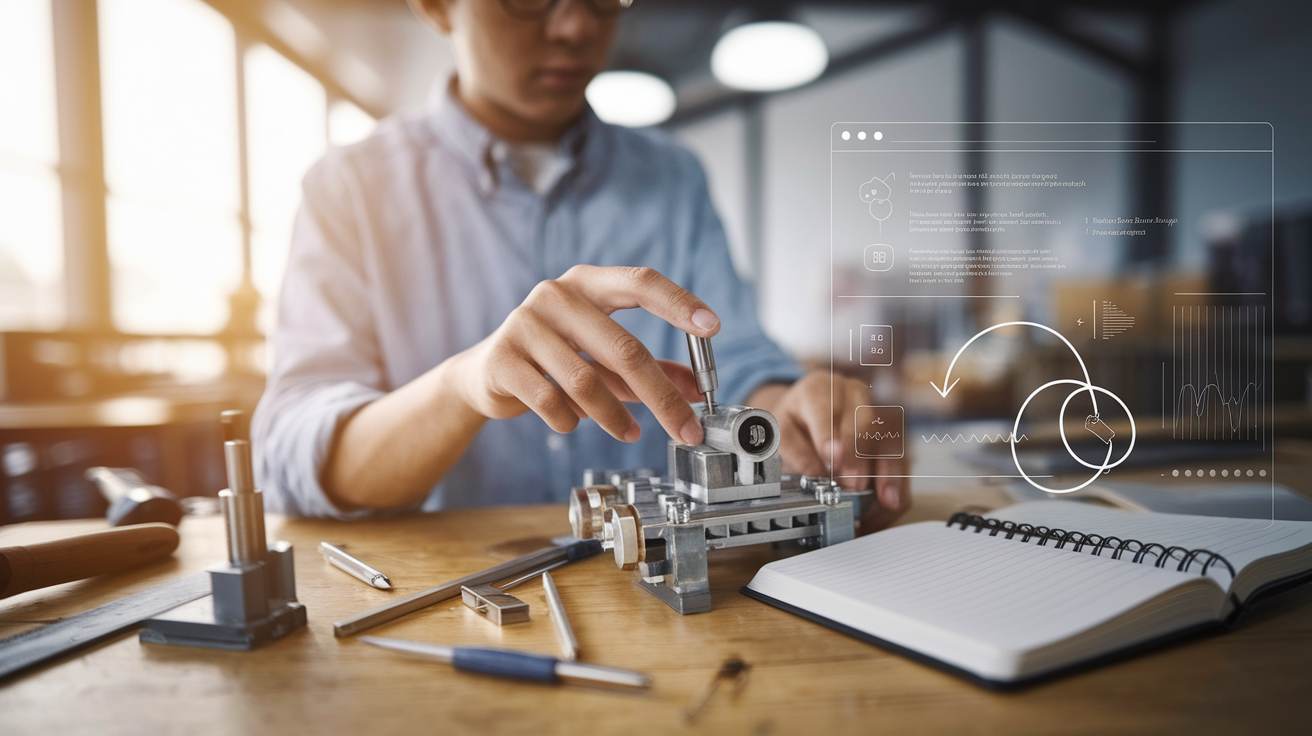
Experiential learning is learning by doing, then thinking about what you did. You don’t sit through lectures and cram facts for a test. You work on real tasks, notice what happens, and use those insights when you tackle the next challenge. Every experience becomes a chance to build skills that actually last.
This flips the usual theory-first classroom on its head. Traditional education explains concepts first, then maybe lets you practice later. Experiential learning starts with practice. You try something. See what works and what doesn’t. Figure out why. Adjust your approach and go again. The knowledge sticks because you built it through action and reflection, not passive listening.
Deep learning happens when you mix reading, discussion, hands-on work, and self-assessment into one ongoing loop. Surface learning is cramming definitions the night before an exam. That gets you short-term recall. Experiential work gets you understanding you can actually use in new situations, because you’ve tested ideas in real contexts and adapted when they failed.
What makes learning experiential:
Active participation. You perform tasks instead of watching someone else do them.
Structured reflection. Guided questions and discussion happen after the experience, not just during.
Real-world application. The tasks mirror what professionals or communities actually do.
Iterative improvement. Each cycle refines your skills based on feedback you got last time.
Learner-centered progression. You set goals and track your own growth over time.
Kolb’s Experiential Learning Cycle Explained
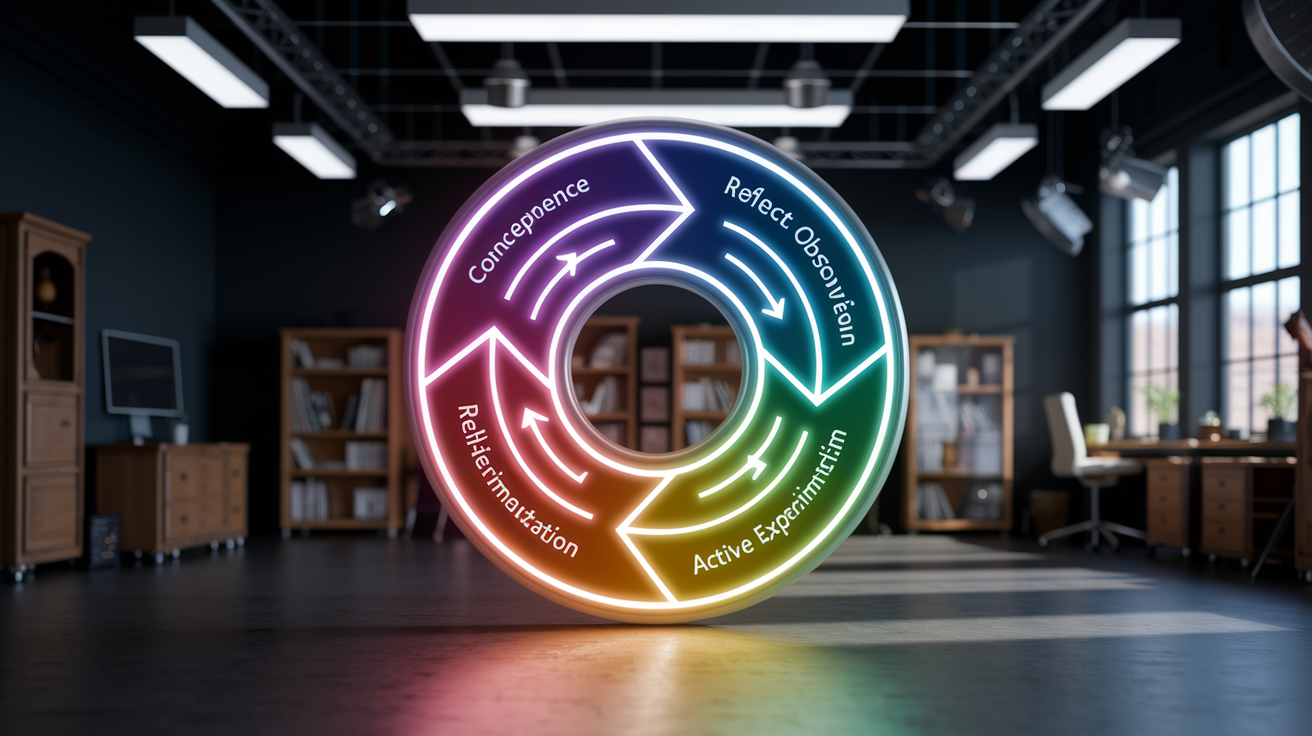
In 1984, educator David Kolb published a four-stage model that’s still the blueprint for designing experiential learning. His cycle shows that learning isn’t a one-time event. It’s a repeating loop where each experience feeds the next one, and reflection is what turns action into insight.
The cycle starts when something happens and ends when you test a new idea, which then becomes the next thing that happens. Teachers and trainers use this model to build lessons that guide you through all four stages instead of stopping after step one.
Concrete Experience
This is the “do” stage. You encounter or perform an activity. Maybe you’re learning to ride a bike, watching a play for the first time, running a chemistry lab, or leading a team meeting. The key is direct involvement. You’re in the situation, not reading about it from a distance.
Concrete experiences work best when they’re safe enough to allow mistakes but real enough to feel meaningful. A simulation that mimics customer service calls counts. So does a field trip to a construction site. The experience creates raw material for what comes next.
Reflective Observation
Now you step back and think about what just happened. Reflection can be guided by prompts like “What went well?” or “What surprised you?” or “What would you change next time?” The goal is noticing patterns, emotions, and results without jumping straight to solutions.
Teachers structure reflection through journals, group discussions, peer feedback, or recorded video review. Without this stage, experiences pile up but don’t turn into learning. Reflection is where you start connecting cause and effect.
Abstract Conceptualization
Here, you form ideas and plans. You might read research, consult an expert, or compare your results to a framework. The question shifts from “What happened?” to “Why did it happen, and what principle explains it?”
This stage links personal experience to broader concepts. If your first customer call went poorly, you might study active listening techniques or review a conflict resolution model. Abstract conceptualization gives you a theory to test in the next round.
Active Experimentation
You test the new idea in practice. You adjust your approach based on what you learned in the previous three stages, then perform the task again. That creates a new concrete experience, and the cycle repeats.
Each loop refines skill and deepens understanding. A teacher might re-teach a lesson using different examples. A student might retry a coding function with clearer variable names. The cycle continues as long as there’s room to improve.
Recommended visual: Insert a circular diagram showing the four stages connected by arrows, with “Concrete Experience” at the top, moving clockwise through Reflective Observation, Abstract Conceptualization, and Active Experimentation, then looping back.
Experiential Learning Styles Within Kolb’s Framework
Not everyone moves through the four-stage cycle the same way. The Kolb Learning Style Inventory identifies nine preferred modes of engaging with experience. These styles describe how people emphasize different parts of the loop. Some lean heavily into doing, others into reflecting or planning.
The nine styles:
Experiencing. Prefers direct, hands-on immersion.
Imagining. Combines concrete experiences with reflective exploration.
Reflecting. Focuses on observation and careful thought before action.
Analysing. Emphasizes critical examination of data and outcomes.
Thinking. Enjoys abstract models and conceptual frameworks.
Deciding. Blends theory with practical planning and choice-making.
Acting. Prioritizes trying things out and adjusting on the fly.
Initiating. Leads experimentation and launches new projects.
Balancing. Moves fluidly across all four stages depending on context.
Recognizing these styles helps instructors design activities that give every learner a chance to engage their strengths while practicing less comfortable stages. A balanced curriculum includes concrete tasks for experiencers, reflection prompts for analysts, planning exercises for thinkers, and quick experiments for actors.
Real-World Experiential Learning Activities and Applications

Experiential learning shows up in classrooms, workplaces, and community settings. The unifying thread is that you gain knowledge by doing something real, not by reading about it in isolation. Below are six common forms used across education and professional development.
Internships and apprenticeships place you in professional roles where you perform job tasks under supervision. Interns test whether a career fits, build workplace skills, and apply classroom theory to real projects. Apprenticeships combine on-the-job training with structured reflection, often leading to industry credentials.
Simulations and role-plays recreate realistic scenarios in a controlled environment. Medical students practice diagnosing virtual patients. Business students role-play negotiations. Drama students perform scripted conflicts. The safety of simulation lets you make mistakes, reflect, and retry without real-world consequences.
Fieldwork and research trips move learning outside the classroom. Biology students collect water samples from a local river. History students visit archives. Engineering students tour manufacturing plants. Field experiences provide context that textbooks can’t, and the novelty increases engagement.
Laboratory practicals and hands-on experiments are core to science education. You design procedures, gather data, troubleshoot equipment failures, and interpret results. Each lab cycle mirrors Kolb’s model. Concrete work, reflective analysis, hypothesis refinement, and retesting.
Project-based learning assigns open-ended tasks that require research, planning, collaboration, and deliverables. You might design a community garden, build a website for a nonprofit, or produce a documentary. Projects integrate multiple skills and force you to manage ambiguity and iterate toward a solution.
Workplace training and micro-internships give employees or students short, focused experiences in new roles or tasks. A two-week shadowing rotation, a one-day simulation workshop, or peer-led skill exchanges all count. These compact cycles accelerate learning by compressing the experience-reflection-experiment loop into a brief window.
Benefits of Experiential Learning for Skill Development
Experiential learning produces outcomes that passive instruction struggles to match. Because you actively solve problems and reflect on results, you retain information longer and transfer skills more reliably to new contexts.
When you build something, break it, figure out why, and rebuild it better, the lesson sticks. Research and practitioner reports consistently show that hands-on cycles improve knowledge retention far beyond what lecture-and-test formats achieve. The act of doing creates memory anchors that reading alone doesn’t.
Key benefits:
Improved retention. You remember and recall information longer.
Stronger problem-solving. Practice navigating ambiguity and failure builds adaptive thinking.
Increased engagement and ownership. Active roles make you invested in outcomes.
Enhanced confidence. Successful iterations prove capability and reduce anxiety.
Better collaboration and teamwork. Group tasks require communication and compromise.
Creativity and critical thinking. Open-ended projects invite original solutions.
Real-world readiness. Skills practiced in realistic settings transfer to jobs and adult life.
Positive attitude toward learning. Experiential tasks feel purposeful, not arbitrary.
These gains matter most for career preparation and lifelong learning. Employers value demonstrated skills. Can you lead a meeting, troubleshoot a system, or manage a project? Not just coursework on a transcript. Experiential learning creates evidence of competence.
Classroom Strategies for Experiential Learning Implementation

Teachers and instructional designers can integrate the experiential cycle into any subject by following a simple repeating pattern. The goal is structuring lessons so students do, reflect, analyse, and test, not just listen and memorize.
Start by providing an experience. Give students a hands-on task, a case study to solve, a simulation to run, or a field observation to complete. The activity should be concrete, time-bound, and connected to a learning objective. It doesn’t need to be elaborate. A ten-minute problem-solving exercise works as well as a week-long project, as long as it produces something to reflect on.
Next, guide structured reflection. Immediately after the activity, ask students to write, discuss, or present what happened. Use prompts: “What did you notice?” “What went differently than you expected?” “What choice would you change?” Reflection techniques include keeping a learning diary, collecting peer feedback, making notes in a workbook after each session, recording and reviewing the activity, or inviting a colleague to observe and debrief together.
Then, critically analyse the experience. Help students connect their observations to concepts, research, or expert guidance. Ask “Why did that approach succeed?” or “What principle explains this result?” This is where abstract conceptualization happens. Students build or refine a mental model that they can apply beyond the current task.
Finally, plan and implement changes. Students take what they learned and test a new approach. That might mean revising a draft, re-running an experiment with adjusted variables, or teaching the same lesson to a new group with modified instructions. This active experimentation creates a fresh concrete experience, and the cycle begins again.
A recommended five-step process for lesson design:
- Design the experience. Choose or create a task aligned to learning goals.
- Run the activity. Students perform the task individually or in groups.
- Facilitate reflection. Use discussion, journals, or feedback forms immediately after.
- Connect to concepts. Introduce or revisit theory, models, or research that explain outcomes.
- Enable iteration. Give students a chance to apply insights and repeat the cycle.
Recommended visual: Insert a simple one-page lesson-plan template with labeled boxes for Experience, Reflection Prompts, Conceptual Links, and Iteration Plan.
Experiential Learning vs Traditional Classroom Learning
Traditional and experiential models prioritize different activities and measure success in different ways. Understanding the contrast helps educators choose when each approach fits best.
Traditional classroom learning often emphasizes knowledge transfer through lecture, assigned reading, and exams that test recall. The teacher presents theory first, and students practice applying it later, sometimes only on a test. This model works well for introducing foundational vocabulary and established facts quickly. It’s efficient for covering broad content in limited time.
Experiential learning reverses the sequence. Students encounter problems or tasks first, develop questions and provisional answers through action, then study theory to refine their understanding. Assessment focuses on demonstrated skill. Can you perform the task, explain your reasoning, and improve your approach? Not just recognition or recall. This model excels at building transferable skills, intrinsic motivation, and long-term retention, but it requires more time per concept and more facilitation than straight lecture.
| Experiential Learning | Traditional Learning |
|---|---|
| Starts with hands-on tasks or problems | Starts with lecture or reading to introduce theory |
| Reflection and iteration are built into lesson design | Reflection is optional; lessons often move to new topics quickly |
| Assessment measures applied skill and reasoning | Assessment measures recall and recognition on exams |
| High retention and transfer to new contexts | Lower retention after exam; limited transfer without practice |
| Time-intensive; fewer topics covered in depth | Efficient for broad content coverage; less depth per topic |
| Learner-centered; students set pace and direction within structure | Teacher-centered; instructor controls pace and content sequence |
Many effective courses blend both models. Use lecture to introduce frameworks efficiently, then switch to experiential cycles for skill practice and deeper understanding.
Measuring Outcomes and Assessing Experiential Learning

Assessing experiential learning requires tools that capture growth, application, and transfer, not just memorization. Traditional multiple-choice exams measure recognition. Experiential assessments measure competence in realistic tasks.
Retention rate tracks how much knowledge and skill students keep over time. Pre-tests and post-tests separated by weeks or months show whether learning sticks. Reflective journals provide qualitative evidence of evolving understanding. Students document what they tried, what they noticed, and how they adjusted their approach across multiple cycles.
Transfer to practice measures whether students apply skills in new contexts. Can a student who learned conflict resolution in a simulation also mediate a real peer disagreement? Can someone who analyzed case studies design a solution for a novel problem? Transfer is the ultimate measure of deep learning.
Attitude change and observed improvement are often reported by teachers and supervisors. Rubrics tailored to hands-on tasks can score collaboration quality, problem-solving process, iteration discipline, and final deliverable quality. Portfolios of student work provide concrete evidence of skill development over time. Photos of prototypes, drafts with revision notes, recorded presentations.
Key metrics for experiential assessment:
Retention rate. Measured via spaced retrieval tests or application tasks weeks after instruction.
Transfer to new contexts. Students solve unfamiliar problems using learned principles.
Reflective depth. Quality and specificity of observations in journals or discussions.
Demonstrated skill improvement. Comparing performance across multiple task cycles.
Competency-based evidence. Portfolios, recordings, or peer evaluations documenting applied work.
Effective rubrics for experiential tasks define clear levels of performance for process (how students approached the task) and outcome (the quality of the result). Formative feedback during the cycle matters more than a single summative grade at the end, because iteration depends on knowing what to adjust before the next attempt.
Final Words
You jumped straight into the heart of experiential learning: learning by doing and reflecting, guided by Kolb’s four-stage cycle.
We covered learning styles, real activities you can try, classroom tactics, benefits for skills, and simple ways to measure results.
If you’re still wondering what is experiential learning—think of it as a loop: try something, reflect, plan, and try again. Try one hands-on activity this week and notice the clearer understanding and bigger confidence it brings.
FAQ
Q: What is experiential learning and give an example?
A: Experiential learning is learning by doing and reflecting; an example is an internship where a learner practices real tasks, gets feedback from a mentor, reflects, and applies improvements to build workplace skills.
Q: What is an example of experiential learning?
A: An example of experiential learning is a science lab where students perform experiments, observe outcomes, discuss results, and then adjust their methods to test new hypotheses.
Q: What are the 5 principles of experiential learning?
A: The five principles of experiential learning are active participation, guided reflection, real-world tasks, iterative improvement through testing, and learner-centered progression that builds understanding by doing and revising.
Q: What are the 4 stages of experiential learning?
A: The four stages of experiential learning are Concrete Experience, Reflective Observation, Abstract Conceptualization (forming ideas), and Active Experimentation (testing changes), forming a continuous learning loop.