Why rebuild the wheel when a ready-made model can do most of the work?
Transfer learning grabs a model trained on a huge dataset and uses it as a head start for your task.
It cuts training time, slashes the labeled data you need, and usually beats training from scratch when examples are scarce.
Think of it like learning to drive a new car—you don’t relearn steering and pedals, you only learn the new quirks.
This post explains what transfer learning is, how to apply it, and when it truly helps (and when it doesn’t).
Core Explanation of Transfer Learning Concepts
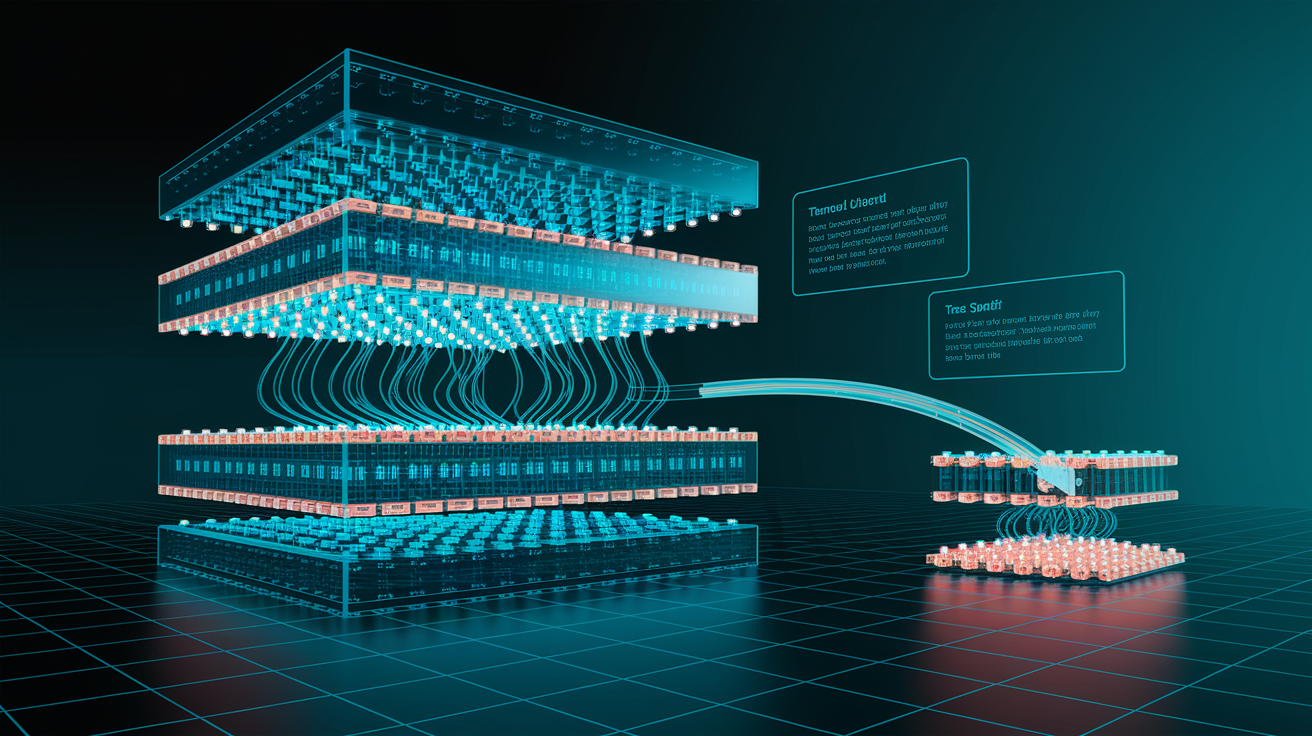
Transfer learning grabs a model trained on one task and uses it as the starting point for something new. You’re not building from zero. You’re taking a model that already understands patterns from a huge dataset and teaching it your specific problem. This cuts training time, shrinks the data you need, and usually beats starting fresh, especially when you don’t have thousands of labeled examples lying around.
Pre-trained models pack reusable knowledge into their layers. Early layers catch general stuff like edges, colors, textures in images, or character and word patterns in text. Later layers pick up high-level meaning like object shapes, scene types, sentiment, or intent. When you load a pre-trained model like VGG (introduced in 2014), ResNet (2015), or BERT (2018), you’re pulling in millions of learned parameters that already recognize foundational patterns. You keep most of that and only teach the final layers to spot your specific categories.
Think about learning to drive a new car. You don’t relearn what steering wheels, pedals, and mirrors do. You transfer that core knowledge and focus on what’s different. Maybe the gear shift moved or the parking brake went electronic. Transfer learning works the same way: it freezes the “steering wheel” layers and retrains only the “gear shift” layers on your small dataset.
The most important parts of transfer learning:
- Cuts down the labeled data you need by reusing patterns from large source datasets
- Taps into pretraining work done by research teams and companies, saving compute and calendar time
- Handles small-data scenarios where collecting thousands of labels isn’t practical or cheap
- Boosts initial model performance and learning speed compared to random initialization
- Makes rapid prototyping and faster iteration possible during development and deployment
Practical Mechanics of Transfer Learning Workflows
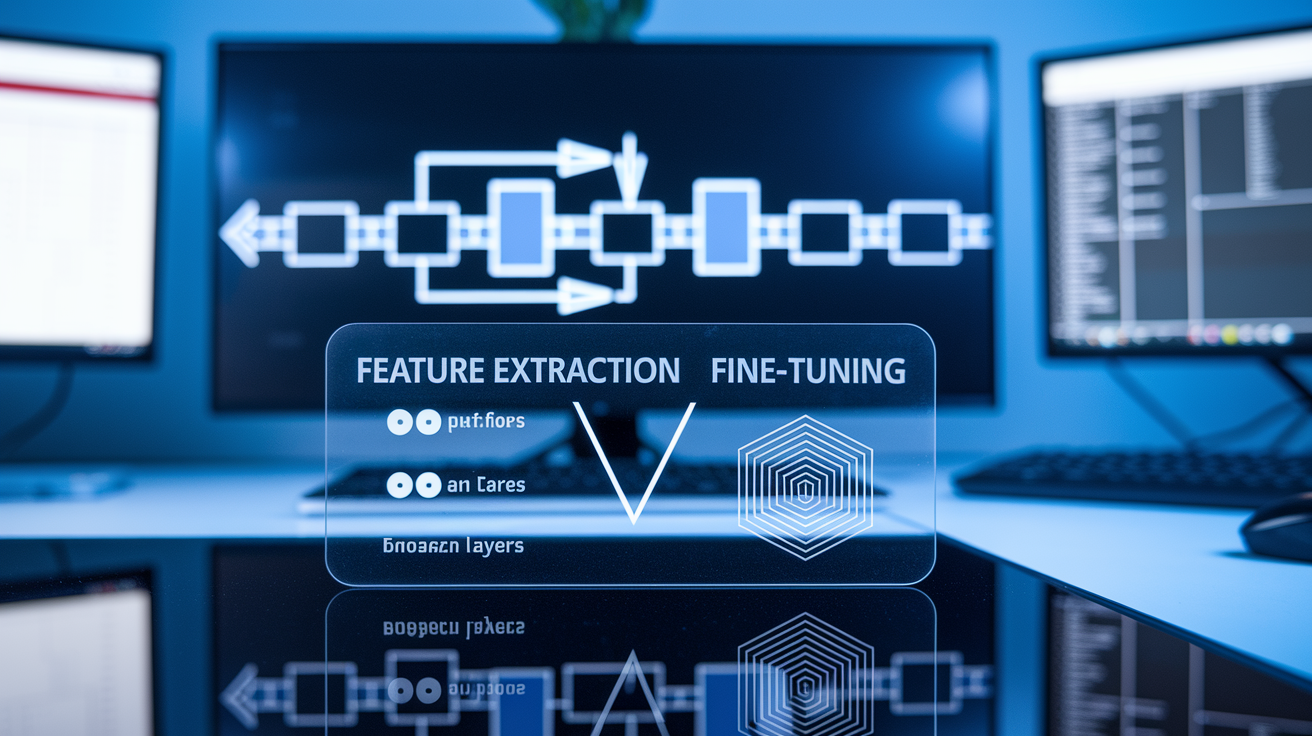
Two main approaches run transfer learning in practice: feature extraction and fine-tuning. Feature extraction freezes all the pre-trained layers except the final classification head. You swap out the output layer with a new one matching your number of classes, then train only that small piece. This works well when your target dataset is small and you want to dodge overfitting. The frozen layers act as a fixed feature extractor, and your new head learns to map those features to your labels.
Fine-tuning unfreezes some or all of the pre-trained layers and keeps training with a small learning rate. You adjust the weights gradually so the model adapts to your domain without forgetting what it learned originally. Fine-tuning works best when your task and the original task are closely related and when you have enough target data to update weights safely. You can fine-tune the whole model or just the top few layers, depending on how different your data is from the source.
A typical transfer workflow has six core steps:
- Prepare your dataset – Collect images, text, or other data, apply any necessary preprocessing, split into training, validation, and test sets.
- Select a pre-trained model – Pick an architecture like VGG, ResNet, or Inception for vision, or BERT for language tasks, based on task similarity and available compute.
- Adapt the architecture – Replace the final output layer to match your number of target classes and make sure input shapes line up with the model’s expectations.
- Pick a transfer strategy – Decide whether to freeze all layers (feature extraction) or unfreeze some/all layers (fine-tuning).
- Tune hyperparameters – Adjust learning rate (start small, often 1e-4 or 1e-5 for fine-tuning), batch size, and number of epochs. Use grid search or random search if time allows.
- Train and evaluate – Monitor validation metrics like accuracy or F1-score. Apply early stopping or dropout to prevent overfitting. Test on a held-out set once training finishes.
Following these steps keeps the process structured and cuts down on silent mistakes like using the wrong learning rate or skipping validation entirely.
Comparing Transfer Learning vs. Training From Scratch
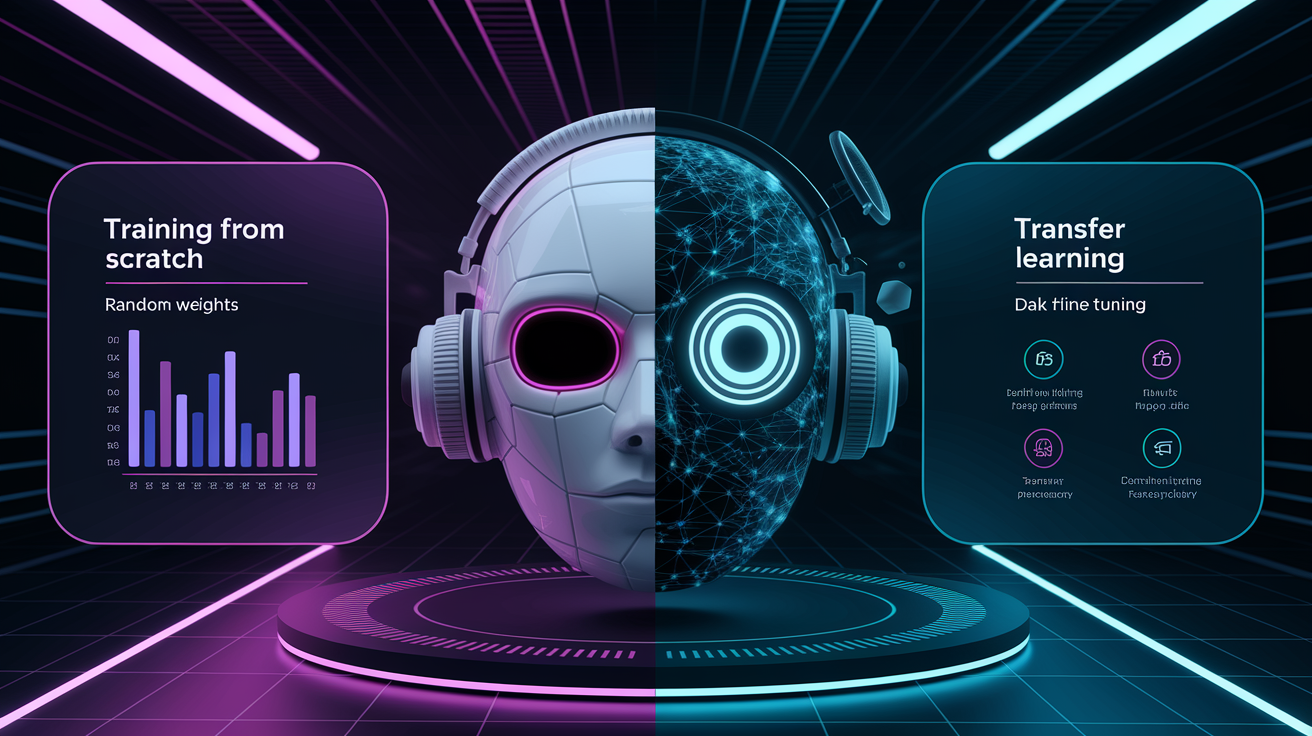
Training from scratch means you start with random weights and learn every pattern from your dataset alone. That needs a large labeled dataset, serious compute power, and long training cycles, sometimes days or weeks on modern hardware. If your dataset is small, a from-scratch model will overfit fast and fail to generalize. If your dataset is huge, you pay the full cost in electricity, GPU hours, and calendar time.
Transfer learning often drops dataset requirements by 80 to 90 percent and shortens development timelines from months to weeks. It improves your starting performance because the model already knows useful patterns. It speeds up learning because you’re refining existing knowledge instead of building it from zero. And it can lift your final accuracy or error rate because the transferred features give you a stronger foundation than random weights ever could.
| Dimension | Training From Scratch | Transfer Learning |
|---|---|---|
| Labeled Data Needed | Large (often 10,000+ samples) | Small to medium (hundreds to thousands) |
| Compute Resources | High (days/weeks on GPUs) | Lower (hours to days) |
| Development Time | Months | Weeks |
| Performance on Small Data | Poor (high risk of overfitting) | Strong (leverages pre-learned features) |
Examples and Applications of Transfer Learning in Practice
Transfer learning pops up across vision, language, and specialized domains. In computer vision, models pre-trained on ImageNet’s 1000 classes get adapted for tasks like medical imaging, defect inspection on factory lines, and product tagging in e-commerce. A manufacturer might fine-tune a ResNet model on images of shoes to classify styles, reusing the edge and texture detectors learned from millions of general images. In natural language processing, BERT (released in 2018) and its variants are fine-tuned for sentiment analysis, named entity recognition, question answering, and summarization, often with just a few hundred labeled examples.
Finance teams use transfer learning to detect fraud by adapting models trained on one market or transaction type to another. Robotics engineers apply sim-to-real domain adaptation, training a policy in simulation and transferring it to physical robots with minimal real-world data. Healthcare researchers fine-tune vision models on chest X-rays or pathology slides, tapping into features learned from everyday photos to spot diseases faster and with smaller labeled datasets. One practical example in NLP involves fine-tuning DistilBERT on a text classification task using a PyTorch DataLoader, where the model learns to label messages as positive (1) or negative based on a small domain-specific corpus.
You can explore thousands of pre-trained models on the Hugging Face model hub, covering vision, language, audio, and multimodal tasks. The hub makes it easy to access both research checkpoints and production-ready architectures, often with one-click downloads and sample code to get started.
Common real-world application categories:
- Image classification and object detection (animals, vehicles, products, faces)
- Medical diagnosis from scans, slides, or waveforms
- Text classification, sentiment analysis, and intent detection in chatbots
- Fraud detection and credit risk modeling in financial services
- Quality inspection and defect detection in manufacturing and logistics
Understanding Domain Similarity, Gaps, and Knowledge Transfer
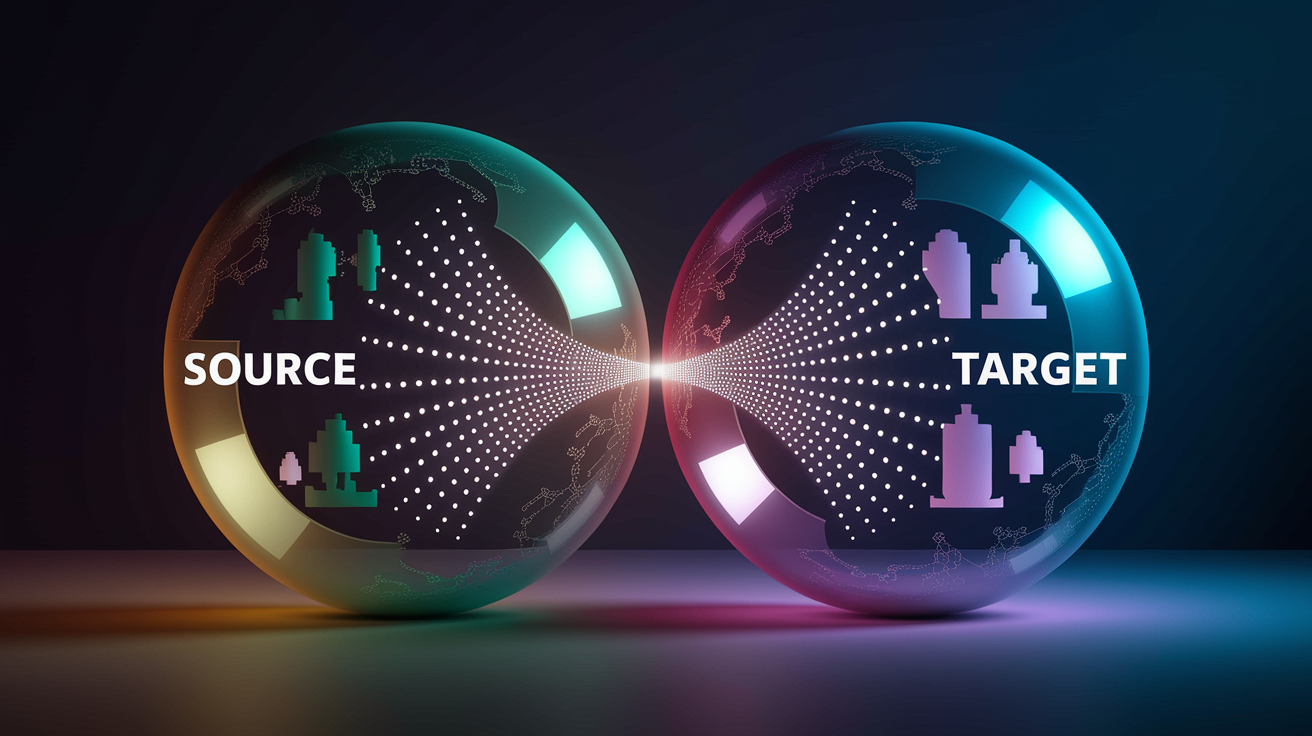
Task similarity and domain overlap determine how much a pre-trained model will help. High task similarity means the source and target tasks share the same type of input and output structure. Classifying dog breeds and classifying cat species are both animal image classification problems. Same modality, similar objectives. High domain similarity means the data distributions look alike. X-rays from two different hospitals are both grayscale medical scans with similar anatomy and artifacts.
Low task similarity happens when the modalities or goals differ sharply. Sentiment analysis on text and landmark recognition in images operate on completely different inputs and require different reasoning. Low domain similarity happens when the visual style, vocabulary, or structure diverges. Medical X-rays and satellite landscape images are both images, but their content, contrast, and semantic meaning are worlds apart. When the domain gap is large, transferred features may not line up well, and performance can drop. That’s called negative transfer. Domain adaptation techniques like adversarial alignment or style transfer can shrink that gap by making the source and target distributions more similar before fine-tuning.
Indicators of domain mismatch you should watch for:
- Validation accuracy plateaus or drops sharply after initial transfer
- Feature distributions measured by metrics like Frechet Inception Distance (FID) or maximum mean discrepancy (MMD) show large divergence
- Model predictions cluster around majority classes from the source dataset instead of adapting to target class balance
- Interpretability checks reveal the model is relying on spurious source-domain patterns (textures, backgrounds) rather than target-relevant features
Common Challenges and Pitfalls in Transfer Learning
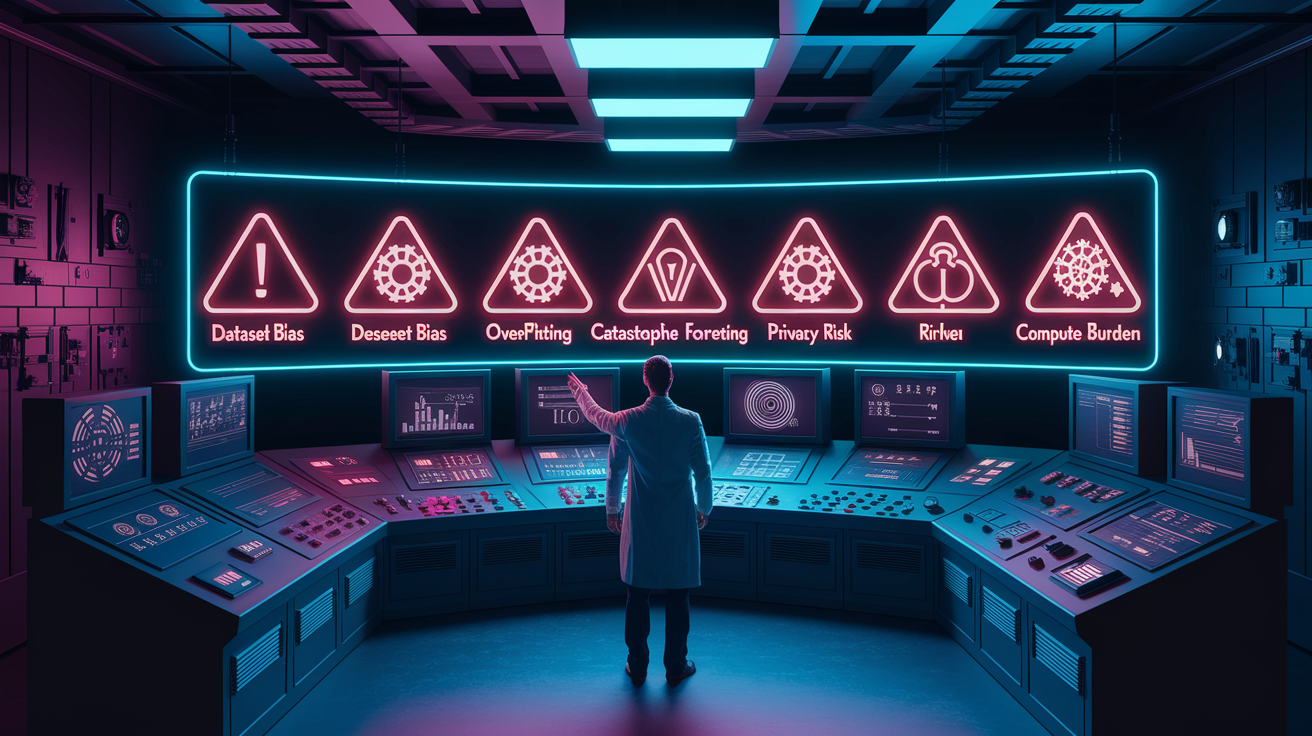
Five common issues show up repeatedly in transfer learning projects. Dataset bias can sneak in when the pre-trained model learned patterns from an unbalanced or skewed source. If ImageNet contains more images of certain breeds or lighting conditions, those biases transfer forward. Overfitting happens when you fine-tune too aggressively on a tiny target dataset, causing the model to memorize labels instead of generalizing. Catastrophic forgetting occurs during fine-tuning when the model overwrites useful source knowledge, losing performance on both tasks. Privacy risks emerge if the pre-trained model was trained on sensitive data and retains traces of it. Large models, especially in NLP, demand serious compute for training and fine-tuning, which can strain budgets and timelines.
Spotting these pitfalls early lets you design safeguards from the start. Testing on diverse holdout slices, monitoring fairness metrics across demographic groups, and using smaller learning rates all cut down on silent failures. You’ll also want to inspect what the model learned by visualizing activations or running ablation studies to confirm it’s relying on the right features.
Mitigation Strategies
Tackling transfer learning challenges takes a mix of data hygiene and training discipline. Start by auditing your source and target datasets for imbalance, label noise, and representation gaps.
Practical mitigation tactics:
- Dataset rebalancing – Oversample underrepresented classes or apply synthetic data augmentation to equalize training signal
- Fairness objectives – Add regularization terms or constraints that enforce equalized odds or demographic parity during training
- Continuous monitoring – Track performance and bias metrics on validation slices throughout training. Stop or roll back if fairness degrades
- Progressive learning and elastic weight consolidation – Gradually unfreeze layers or penalize large weight changes to preserve source knowledge while adapting to the target
- Multi-source transfer and meta-learning – Combine knowledge from several related domains or use meta-learning techniques to learn how to adapt quickly with minimal target data
Tooling and Frameworks for Implementing Transfer Learning
TensorFlow and PyTorch are the two most common frameworks for transfer learning. TensorFlow Hub and PyTorch Hub host hundreds of pre-trained models you can load with a few lines of code. Both frameworks support layer freezing, learning rate scheduling, and custom training loops, giving you full control over which weights update and how fast. ONNX (Open Neural Network Exchange) provides a standard format for exporting models across frameworks, so you can train in PyTorch and deploy in TensorFlow Lite or vice versa.
Most pre-trained image models expect input shapes like (224, 224, 3) for RGB images. If your data is grayscale or a different resolution, you’ll need to resize or add channels before feeding it in. NLP models from the Hugging Face hub handle tokenization automatically and let you swap the final classification head to match your label count. When you load a model, you typically replace the top layer, freeze the rest, and train. After initial convergence, you can unfreeze deeper layers and fine-tune end-to-end with a smaller learning rate.
| Framework | Typical Use Case | Example Models |
|---|---|---|
| TensorFlow / Keras | Vision, structured data, production deployment | VGG16, ResNet50, Inception, EfficientNet |
| PyTorch | Research prototyping, custom architectures, NLP | ResNet, BERT, DistilBERT, GPT variants |
| ONNX | Cross-framework portability, edge deployment | Any model exported from TensorFlow or PyTorch |
You can browse and download thousands of models from the TensorFlow Hub models page or the Hugging Face model hub. Both hubs include sample code, training stats, and license information, making it easy to pick a starting point that fits your task and compute budget.
Final Words
We jumped straight into how transfer learning reuses pretrained models, the practical mechanics (feature extraction and fine-tuning), comparisons with training from scratch, hands-on examples, domain gaps, common pitfalls, and tooling to get going.
You should now see the main trade-offs: less data and compute, quicker results, but watch for negative transfer and bias. Choose your strategy and monitor performance.
If you still ask what is transfer learning, it’s starting from a model that already learned useful features and adapting it to your task so you train less and get faster wins. Try a small fine-tuning run and you’ll see real progress.
FAQ
Q: What is an example of transfer learning?
A: An example of transfer learning is using an ImageNet-pretrained model, freezing early convolutional layers, then retraining only the final layer on a small custom image classification dataset.
Q: What are the five types of transfer learning?
A: The five types of transfer learning are instance-based (reweight examples), feature-representation (learn shared features), parameter-based (share model weights), relational-knowledge (transfer rules), and hybrid approaches.
Q: What is the difference between CNN and transfer learning?
A: The difference between a CNN and transfer learning is that a CNN is a neural network architecture for images, while transfer learning is a strategy that reuses pretrained models (including CNNs) for new tasks.
Q: Is transfer learning the same as deep learning?
A: Transfer learning is not the same as deep learning; transfer learning is a technique that reuses pretrained models, whereas deep learning is the broader field of building and training deep neural networks.